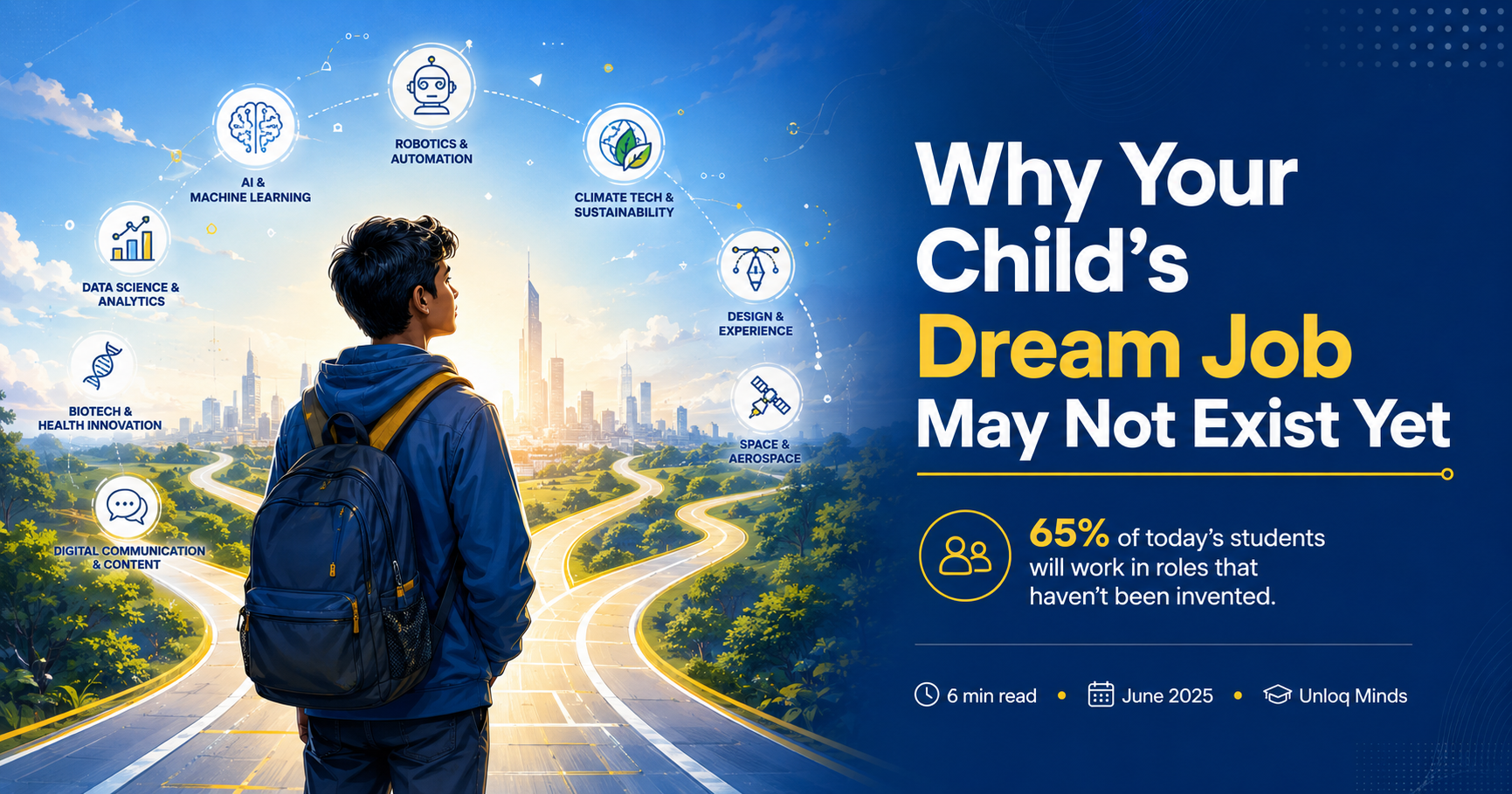
65% of today’s students will work in roles that haven’t been invented. That’s not a threat — it’s a reframing.
In the year 2000, the job title “social media manager” did not exist. Neither did “data scientist,” “UX researcher,” “prompt engineer,” or “climate tech strategist.” These aren’t niche roles today — they’re some of the fastest-growing, highest-paying careers on the planet. What were they twenty years ago? Not even a thought in anyone’s strategic plan.
A fifteen-year-old in Class 10 today will enter the workforce around 2030 to 2032. The World Economic Forum estimates that 65% of children currently in primary school will work in job types that haven’t been invented. For high school students, the fraction is lower — but by conservative estimate, a significant portion of the roles today’s Class 11 and 12 students will hold over their careers don’t yet have names.
“We are asking the wrong question. ‘What do you want to be?’ implies a fixed destination in a world that has become radically unfixed.”
This should not be terrifying. It should be liberating — because it means the question “what do you want to be when you grow up?” is a trap. It assumes a stable landscape in the middle of a landslide. The better question — the one that the world’s leading education systems are slowly building curricula around — is this: what kind of thinker do you want to be?
What the world’s leading education systems are doing differently
Finland, Singapore, and Canada have quietly shifted from curriculum delivery to capability building. They haven’t abandoned content — they’re teaching students how to be learners. Adaptive, persistent, collaborative, creative learners who can acquire new expertise as the world shifts beneath them. India’s exam culture has always had hidden strengths here. Students who crack JEE or NEET have proved something powerful: they can learn anything they commit to. That capacity — the ability to absorb a subject ruthlessly and completely — is the real asset. The problem is we forget to say this. We treat the exam as the destination instead of the launchpad.
The next time your child says “I don’t know what I want to do,” consider celebrating that honesty. The students who will thrive are the ones who stay curious enough to find out.
Here are your six fully written, publication-ready blog posts — click any card to read the full essay. Here’s a quick editorial overview of the set:
The arc of the series moves from the immediate (the exam you’re preparing for) outward to the global (how India compares to the world) and then inward again (what high performers quietly do differently). Together they position Unloq Minds not just as a coaching institute but as a voice on the future of education.
Leave a Reply